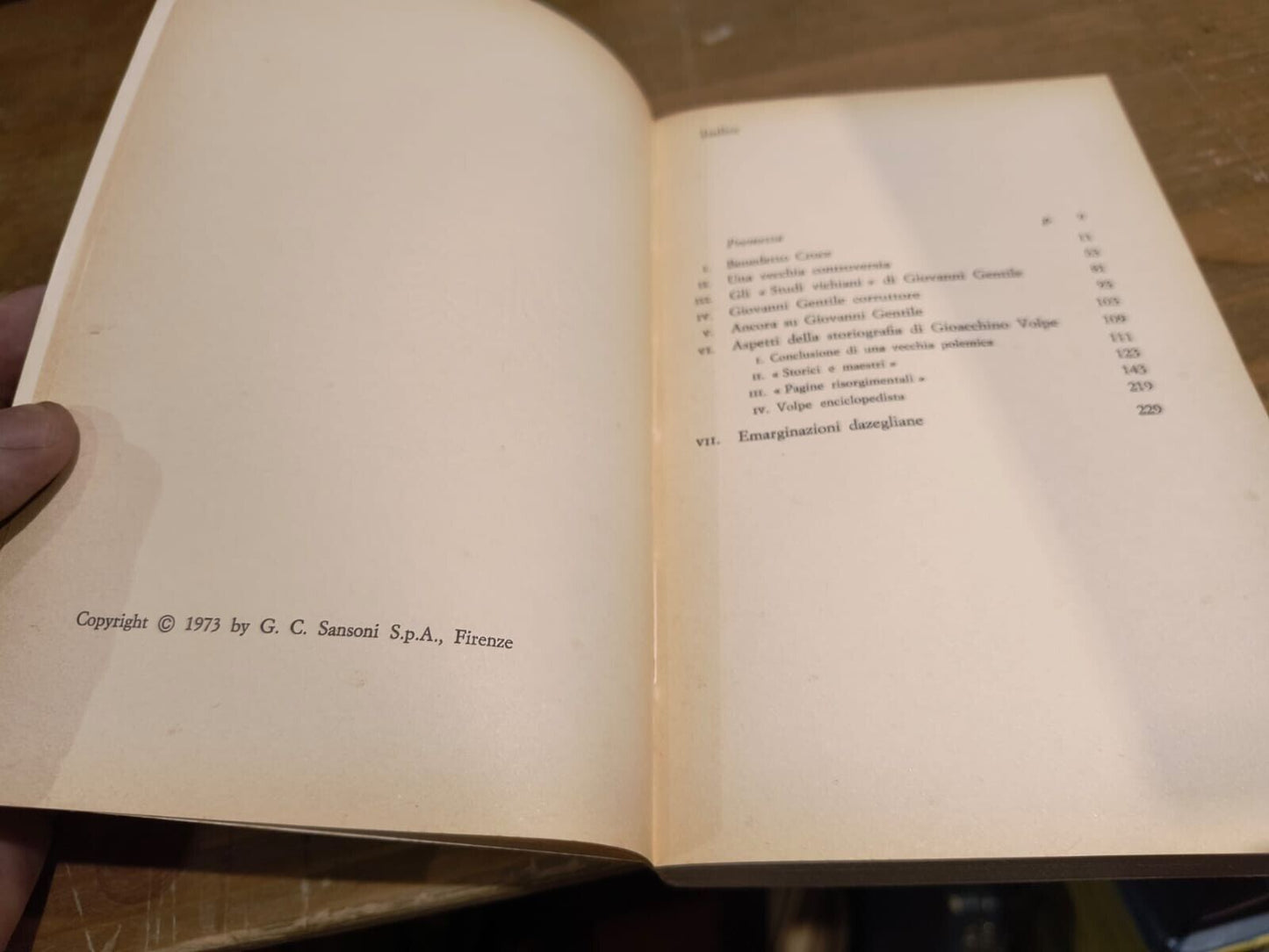
- (Philosophy) CROCE, GENTILE AND OTHER STUDIES. Nicola Nicolini. Sansoni. 1973. Paperback. Good condition. pp. 290.MN655 BIOGRAPHY ON BENEDETTO CROCE: He was born in Pescasseroli, Abruzzo, to a wealthy and influential Neapolitan family and grew up in a deeply Catholic environment. However, while still an adolescent, he distanced himself from Catholicism and never returned to traditional religiosity throughout his life. He lost his parents and sister during the Casamicciola earthquake on 28 July 1883 while he was on holiday with his family on the island of Ischia. Croce had contact with the exponents of the New Italy, including Labriola who introduced him to Marxism and neo-idealism. In January 1903, the first issue of his magazine La critica was published, printed at his own expense until 1906 when the publisher Laterza took over. He was appointed senator in 1910 and from 1920 to 1921 he was Minister of Public Education in the 5th and last Giolitti government. He definitively broke with fascism, after the Matteotti murder. In the same year he also broke with Giovanni Gentile, who had already been collaborating with his magazine "La critica" since 1903, due to philosophical and political differences. Gentile, with the publication of the Manifesto of Fascist Intellectuals in 1925, definitively sided with fascism and Croce responded by publishing in turn in Il Mondo, the Manifesto of Anti-Fascist Intellectuals in which the violence and suppression of freedom of the press by the regime were denounced. He then distanced himself from political life[1] until the end of the Second World War and, in the political confusion that it brought, he tried to mediate between the various anti-fascist parties. In fact, he was Minister without portfolio in the second Badoglio Government (1944). He also joined the first Bonomi Government, again as minister without portfolio, just after the liberation of Rome, only to resign a few months later, on 27 July. From 1943 he was president of the Liberal Party, leaving it in 1946 due to disagreement with the choice in favour of the monarchy. He was part of the Constituent Assembly. In 1946 he founded the Italian Institute for Historical Studies in Naples, allocating an apartment he owned for its headquarters, next to his own home and library, in the Palazzo Filomarino. BIOGRAPHICAL NOTE ON GIOVANNI GENTILE: Giovanni Gentile (Castelvetrano, 30 May 1875 – Florence, 15 April 1944) was an Italian philosopher and pedagogue. Together with Benedetto Croce, he was one of the major exponents of idealism, and an important protagonist of Italian culture in the first half of the twentieth century.